How to use ChatGPT for keyword research
A safe keyword research workflow that uses ChatGPT for expansion, intent grouping, content planning, and brief creation without fake volume data.
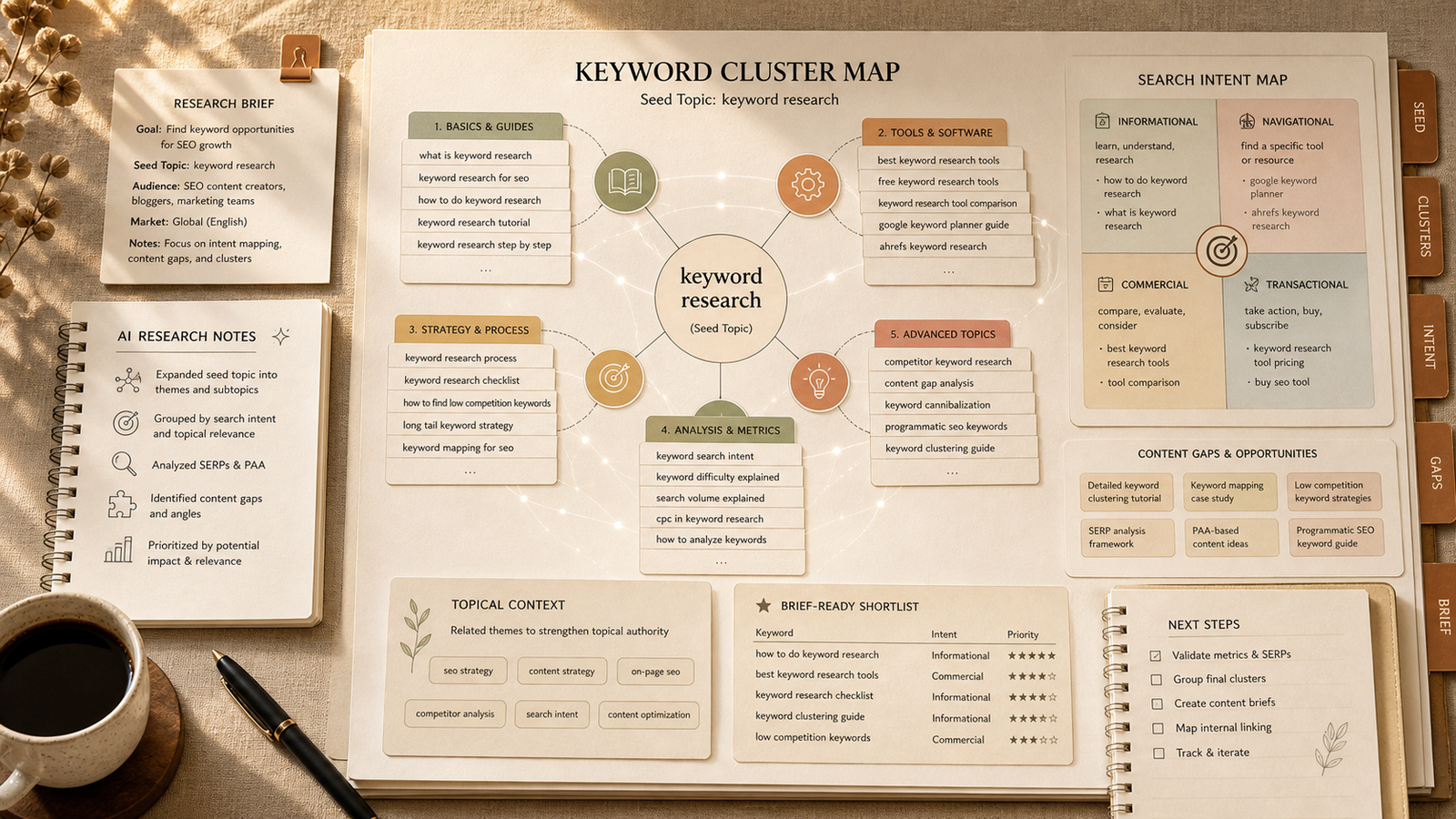
Introduction
Use ChatGPT for structure, not fake metrics.
Keyword research needs ideas, intent, prioritization, and evidence. ChatGPT can help with the first three, but it should not invent search volume, ranking difficulty, or current competitor data.
A reliable workflow uses AI to organize the research and uses verified sources when numbers or current SERP facts matter.
Why this matters
Keyword lists are less useful than intent maps.
A raw keyword list does not tell you what to publish. You need to know whether the searcher wants a definition, tutorial, comparison, checklist, template, or tool.
ChatGPT is useful because it can help turn messy ideas into intent groups and article angles.
Core problem
AI can make false precision feel credible.
The danger is not that AI suggests bad ideas. The danger is that it may present invented metrics with confident formatting.
Avoid asking for exact volume unless your workflow includes a verified data source.
Workflow
Keyword research with ChatGPT.
Use AI to shape the research before choosing final topics.
List seed topics from your audience problems and existing resources.
Ask ChatGPT to expand into related questions, use cases, and long-tail phrases.
Group ideas by informational, comparison, template, workflow, and tool intent.
Identify cluster hubs and supporting articles.
Check final candidates with verified search or analytics data when needed.
Create article briefs for the topics that fit your site strategy.
Example prompt
Keyword expansion and intent prompt.
Use this prompt to generate organized keyword ideas without fake metrics.
Copy-ready prompt
Act as an SEO strategist. Starting from the seed topic [TOPIC], suggest keyword ideas grouped by search intent and reader stage. Do not invent search volume, CPC, ranking difficulty, or current SERP facts. For each group, include likely reader problem, recommended content format, internal link opportunities, and questions to verify with real data.
Practical use case
Building an AI SEO topic cluster.
For a seed topic like AI SEO, ChatGPT can suggest clusters around content briefs, WordPress workflows, FAQ schema, internal linking, calculator site SEO, and agent skills.
The next step is not publishing all of them at once. Choose the topics that match your resources and create useful pages with clear CTAs.
Tools needed
A realistic keyword workflow stack.
You need ChatGPT or another AI assistant for ideation, a spreadsheet or notes app for grouping, your own site structure, and verified data sources where metrics matter.
NEOA can help you turn the selected ideas into briefs and repeatable SEO workflows.
Mistakes to avoid
Do not outsource strategy completely.
AI can propose topics, but you still need to decide what your site can credibly cover and what your audience actually needs.
Avoid chasing every keyword variation. Build clusters where you can provide practical depth.
Recommended NEOA resource
Turn keyword groups into free workflows.
Use the free SEO Agent Skill Pack to turn validated keyword groups into briefs, FAQ ideas, and internal link plans.
Then save the workflow to your dashboard so you can reuse it on future clusters.
Detailed workflow
Separate ideation from verification.
ChatGPT is useful for keyword research when it organizes thinking. It becomes risky when it pretends to know exact search volume, difficulty, or current SERP details without verified data.
Use AI for expansion, grouping, and briefing. Use verified sources when you need numbers or current search results.
Seed topics: start with products, audience problems, existing articles, and free NEOA resource themes.
Expansion: ask for related questions, beginner phrases, workflow phrases, templates, tools, and comparison angles.
Intent grouping: group ideas by learn, solve, compare, template, tool, and implementation intent.
Cluster planning: choose one hub page and several supporting articles that link naturally together.
Verification: check final candidates with real search, analytics, or SEO tool data when priority depends on metrics.
Briefing: turn selected topics into article briefs with examples, internal links, FAQs, and review risks.
Improved prompt
Keyword research prompt with guardrails.
This prompt keeps the model useful without letting it invent SEO data.
Copy-ready prompt
Act as an SEO strategist. Starting from [SEED TOPIC], generate keyword and question ideas grouped by intent. Do not invent search volume, difficulty, CPC, traffic, or current ranking data. For each group, include reader problem, likely content format, cluster role, internal links from [APPROVED URL LIST], what data should be verified externally, and one practical article angle. Prioritize useful workflows over keyword stuffing.
Checklist
Keyword research QA checklist.
Use this before turning an AI keyword list into content.
No exact volume, CPC, ranking difficulty, or SERP claim is treated as true unless externally verified.
Every keyword group has a reader problem and a content format.
The cluster includes internal links to prompts, skills, resources, or tools where helpful.
The chosen topics match what the site can credibly explain or provide.
The final brief includes examples and a review step before drafting.
NEOA workflow
Use this how to use ChatGPT for keyword research guide inside the AI SEO hub.
Treat "How to use ChatGPT for keyword research" as one part of the broader NEOA AI SEO workflow. Start from the hub when you need the surrounding topic cluster, then adapt the prompt, run the SEO Content Agent, and save the free resource for repeatable use.
Open the AI SEO hub to see where this guide fits in the full keyword-to-refresh cycle.
Use the Prompt Library or Prompt Generator to adapt the example prompt for your site and audience.
Use the SEO Content Agent and free SEO Agent Skill Pack when the workflow should become repeatable.
Keep the final output human-reviewed before publishing, refreshing, or adding structured data.
Related agent skill
SEO Content Agent Skill
A structured agent skill for turning a keyword into a full SEO content brief, article outline, metadata, FAQ schema plan, and social distribution assets.
Free NEOA resource
Try the free NEOA Prompt Generator
Use the free beta tool to customize keyword research prompts for your audience, format, tone, and constraints.
View resourceFree prompt pack
Get the prompt pack behind practical AI workflows.
Download 50 prompts for SEO, content, research, and business automation, then use them with this guide to make the workflow repeatable.
Free download
Get the prompt pack.
Choose your main interest and unlock the Markdown download.
Free during NEOA beta. You can download after submitting the form.
FAQ
Common questions
Can ChatGPT give accurate keyword volume?
Not reliably by itself. Use it for ideation and grouping, then verify volume and current SERP details with appropriate data sources.
What should ChatGPT do in keyword research?
It can expand seed topics, group intent, suggest content formats, identify questions, and prepare briefs.
How do I avoid bad AI keyword research?
Do not ask for fake metrics. Require assumptions to be flagged and verify priority topics before publishing.
What should I never ask ChatGPT to invent for keyword research?
Do not ask it to invent exact search volume, current ranking difficulty, CPC, traffic estimates, or live competitor facts unless your setup includes verified data.
How can ChatGPT help after I choose a keyword?
It can help create a content brief, article structure, examples, internal link plan, FAQ candidates, and review checklist.
Final recommendation
Make the workflow repeatable before you scale it.
Use ChatGPT as a research assistant and strategist, then verify metrics and SERP details where accuracy matters.