How to refresh old blog posts with AI
A practical content refresh workflow that uses AI to audit old posts before rewriting, expanding, linking, and republishing.
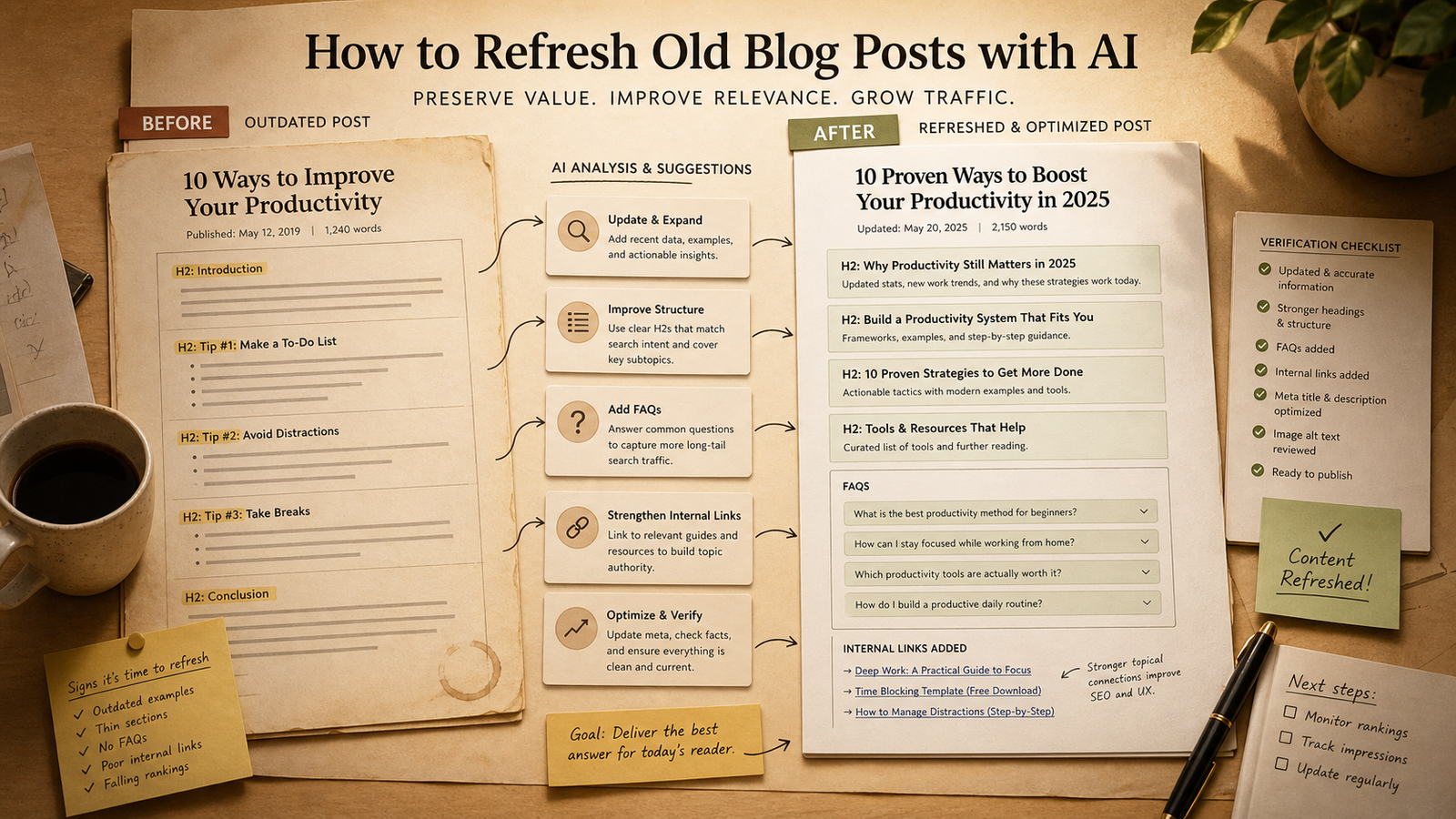
Introduction
A refresh is not a rewrite by default.
Old posts can become outdated, thin, misaligned with intent, or disconnected from newer site resources. AI can help find those issues quickly.
But a full rewrite is often too blunt. The right refresh might be a new example, better intro, stronger FAQ section, updated links, or clearer metadata.
Why this matters
Existing content already has context.
An old article may have backlinks, internal links, history, and a role in your topic cluster. Treating it as disposable can create unnecessary risk.
A refresh workflow helps you improve the page while preserving what still works.
Core problem
AI can overproduce edits.
When asked to improve an article, AI may change tone, remove specifics, add generic paragraphs, or invent updates.
The solution is to ask for a diagnosis and refresh plan before asking for revised copy.
Workflow
Audit-first refresh process.
Use this process before editing any old post.
Paste the current post, title, URL, target keyword, and known performance context if available.
Ask AI to identify intent mismatch, outdated claims, thin sections, and missing examples.
Request keep, revise, remove, and add recommendations by section.
Generate replacement copy only for approved sections.
Add internal links to related guides, prompts, resources, and skills.
Run a final editorial QA for facts, usefulness, tone, and formatting.
Example prompt
Old post refresh audit prompt.
Use this prompt before rewriting.
Copy-ready prompt
Act as an SEO content editor. Audit this old blog post: [PASTE POST]. Identify current reader intent, sections to keep, sections to revise, outdated claims to verify, missing examples, internal link opportunities, FAQ improvements, metadata improvements, and risks. Do not rewrite yet. Create a prioritized refresh plan.
Practical use case
Refreshing a prompt engineering guide.
An old prompt engineering guide might need updated examples, a better workflow checklist, links to the Prompt Generator, and clearer warnings about unsupported claims.
The refresh should make the article more actionable, not just longer.
Tools needed
What to prepare.
Prepare the current post, target keyword, related pages, internal link candidates, and any facts that need verification.
NEOA's free resources can support the prompt and checklist parts of the refresh.
Mistakes to avoid
Do not remove useful context.
Avoid rewriting sections that already answer the reader well. Avoid deleting examples that make the article specific.
Also avoid changing title, slug, or structure just because AI suggests a cleaner version. Use editorial judgment.
Recommended NEOA resource
Use a reusable refresh workflow.
The free SEO Agent Skill Pack includes workflow patterns you can adapt for content refreshes.
Save the refresh prompt to your dashboard so the same audit structure is available the next time you update old content.
Detailed workflow
Refresh by diagnosis, not by rewriting everything.
A strong content refresh starts by identifying what is still useful and what is failing. AI can accelerate that diagnosis if you give it the current post and enough site context.
The goal is targeted improvement: clearer intent, better examples, stronger links, updated sections, and fewer unsupported claims.
Capture the current title, URL, target keyword, article body, headings, and internal links.
Ask AI to identify intent mismatch, outdated claims, missing examples, thin sections, and duplicate paragraphs.
Create a keep, revise, remove, and add plan before generating new copy.
Rewrite only approved sections, with a reason for each change.
Add internal links to relevant prompts, skills, resources, tools, and free downloads.
Review the final page for factual accuracy, usefulness, formatting, schema, and CTA clarity.
Improved prompt
Content refresh audit prompt.
This prompt makes the model audit before it writes.
Copy-ready prompt
Act as an SEO content refresh editor. Audit this old post: [PASTE POST]. Use the target keyword [KEYWORD] and these approved internal links [URL LIST]. Identify current search intent, sections to keep, sections to revise, sections to remove, missing practical examples, outdated claims to verify, internal link opportunities, FAQ improvements, metadata improvements, and risks. Do not rewrite yet. Return a prioritized refresh plan with reasons for each change.
Checklist
Old post refresh checklist.
Use this checklist to keep the refresh focused.
The refresh plan explains why each section is being changed.
Useful original examples are preserved or improved instead of removed.
New claims are verified before publication.
Internal links connect the old post to newer prompts, skills, resources, or tools.
FAQs answer current reader objections rather than repeating the article.
The final page still matches the original URL's purpose unless a deliberate strategy change was made.
NEOA workflow
Use this how to refresh old blog posts with AI guide inside the AI SEO hub.
Treat "How to refresh old blog posts with AI" as one part of the broader NEOA AI SEO workflow. Start from the hub when you need the surrounding topic cluster, then adapt the prompt, run the SEO Content Agent, and save the free resource for repeatable use.
Open the AI SEO hub to see where this guide fits in the full keyword-to-refresh cycle.
Use the Prompt Library or Prompt Generator to adapt the example prompt for your site and audience.
Use the SEO Content Agent and free SEO Agent Skill Pack when the workflow should become repeatable.
Keep the final output human-reviewed before publishing, refreshing, or adding structured data.
Related agent skill
SEO Content Agent Skill
A structured agent skill for turning a keyword into a full SEO content brief, article outline, metadata, FAQ schema plan, and social distribution assets.
Free NEOA resource
Download the free NEOA SEO Agent Skill Pack
Use the free beta pack to standardize content refresh audits, internal links, FAQ planning, and review checks.
View resourceFree prompt pack
Get the prompt pack behind practical AI workflows.
Download 50 prompts for SEO, content, research, and business automation, then use them with this guide to make the workflow repeatable.
Free download
Get the prompt pack.
Choose your main interest and unlock the Markdown download.
Free during NEOA beta. You can download after submitting the form.
FAQ
Common questions
Should every old post be refreshed?
No. Refresh posts that are outdated, strategically important, thin, disconnected from newer pages, or no longer aligned with reader intent.
Can AI decide what facts are outdated?
AI can flag likely review areas, but current facts should be verified with reliable sources before publishing.
What is the first refresh step?
Run an audit that separates keep, revise, remove, and add decisions before generating new copy.
What should I preserve when refreshing an old post?
Preserve useful examples, accurate explanations, strong links, and any structure that still matches reader intent.
Should AI write the refresh plan or the new copy first?
Ask for the refresh plan first. New copy should come after you approve the keep, revise, remove, and add decisions.
Final recommendation
Make the workflow repeatable before you scale it.
Use AI to audit and plan the refresh first. Rewriting should be targeted, verified, and aligned with the page's current job.