Content Automation
How to build an AI editorial calendar for SEO
A practical method for turning keywords, topic clusters, prompts, and review steps into an AI-assisted SEO publishing calendar.
Introduction
Start with the SEO decision, not the AI output.
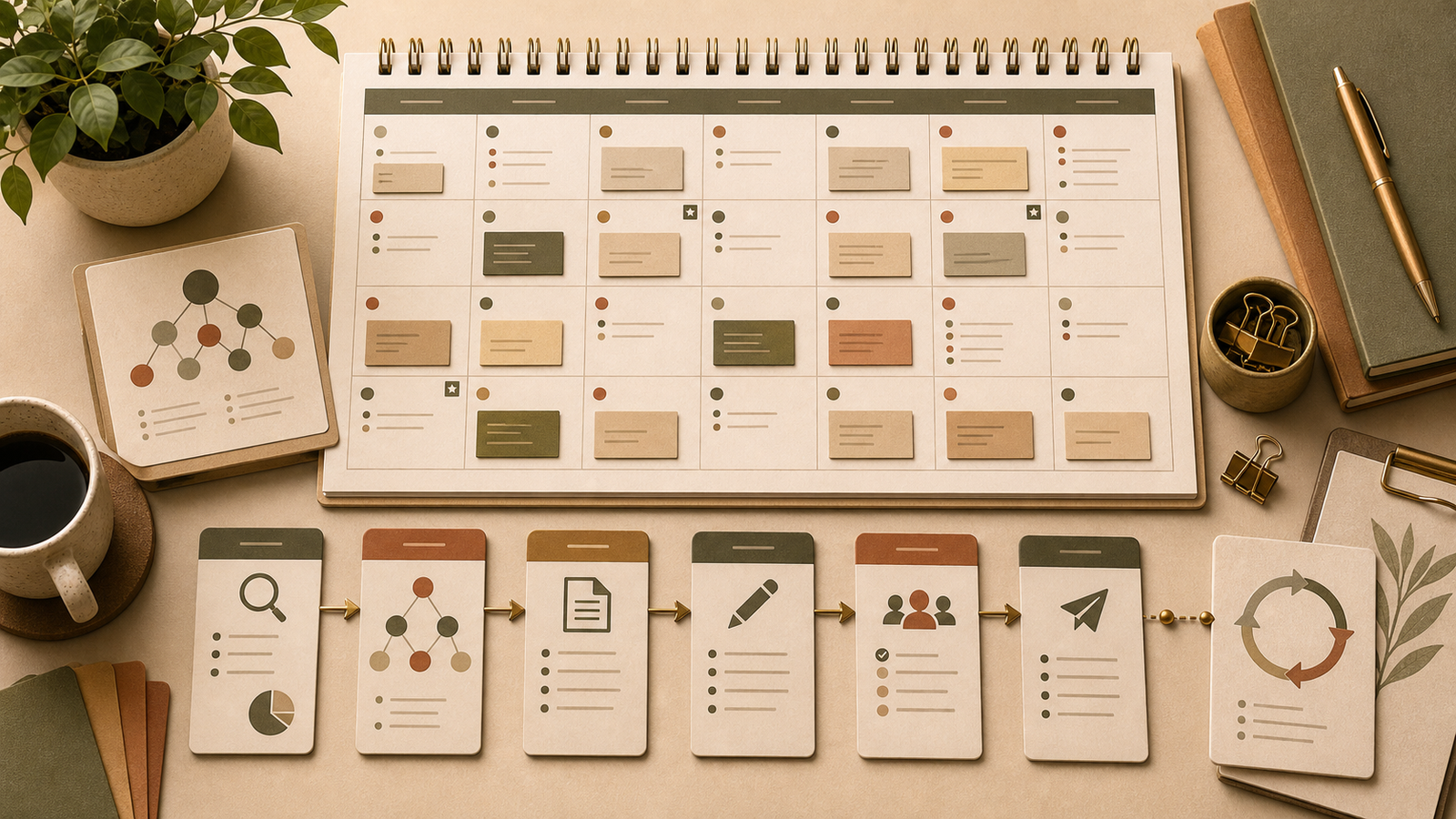
An AI editorial calendar for SEO should organize decisions: what to publish, why it matters, what resource it supports, and when to review it.
Why this topic matters
AI is most useful when it improves repeatable SEO work.
SEO publishing becomes easier when the calendar shows how each article supports a cluster, resource, prompt, or workflow.
AI can quickly organize ideas into themes and sequences, but the final plan should fit your real capacity and editorial standards.
Core SEO problem
The problem to solve before scaling the workflow.
The core SEO problem is random publishing. A list of keywords does not explain which pages should be created first or how they connect.
A useful AI calendar makes page purpose, internal links, and review tasks visible before writing starts.
Step-by-step AI workflow
A calendar workflow for AI-assisted SEO.
Use AI to map topics into a calendar, but base publishing order on audience needs, cluster gaps, resource readiness, and editorial capacity.
List topic clusters, target keywords, planned resources, existing content, and business priorities.
Ask AI to group ideas by hub, supporting guide, tool, prompt, and refresh opportunity.
Assign each article a page purpose, target reader, related resource, and review owner.
Create a publishing sequence that balances new guides and content refreshes.
Add brief deadlines, draft deadlines, review steps, and internal link updates.
Review the calendar monthly and adjust based on quality gaps, not just volume.
Example prompt
Copy-ready prompt starter.
Use this prompt as a starting point, then customize the placeholders with your site, audience, and approved internal links.
Copy-ready prompt
Act as an SEO editorial calendar planner. Use this topic list [TOPICS], existing URLs [URLS], resource list [RESOURCES], audience [AUDIENCE], and monthly capacity [CAPACITY]. Create a 90-day calendar with article purpose, cluster, target keyword, related free resource, brief deadline, draft deadline, review step, internal link updates, and refresh tasks. Do not prioritize volume over usefulness.
Practical example
What this looks like in real work.
For NEOA's AI SEO cluster, the calendar can group audit prompts, topic clusters, product page SEO, content upgrades, measurement, and automation into a sequence after the first 20 guides.
Each new article can link back to the AI SEO hub and the free SEO Agent Skill Pack so the cluster stays connected.
Checklist
How to build an AI editorial calendar for SEO review checklist.
Use this checklist before turning the AI editorial calendar for SEO workflow into a saved template, prompt, or article update.
Confirm this step has a reviewable output: List topic clusters, target keywords, planned resources, existing content, and business priorities.
Confirm this step has a reviewable output: Ask AI to group ideas by hub, supporting guide, tool, prompt, and refresh opportunity.
Confirm this step has a reviewable output: Assign each article a page purpose, target reader, related resource, and review owner.
Confirm this step has a reviewable output: Create a publishing sequence that balances new guides and content refreshes.
Confirm this step has a reviewable output: Add brief deadlines, draft deadlines, review steps, and internal link updates.
Confirm this step has a reviewable output: Review the calendar monthly and adjust based on quality gaps, not just volume.
Tools needed
Keep the stack simple and reviewable.
You need existing URLs, planned article ideas, cluster goals, available resources, publishing capacity, and review requirements.
NEOA's AI SEO hub, Prompt Library, and dashboard can help store the calendar prompts and next actions.
Mistakes to avoid
Where this workflow can go wrong.
For AI editorial calendar for SEO, weak output usually looks polished while skipping context, verification, or reader-specific examples.
Letting AI schedule content without knowing team capacity.
Publishing disconnected keywords instead of topic clusters.
Forgetting refresh tasks and internal link updates.
Using the calendar as a volume target instead of a quality control system.
How to use this inside NEOA
Turn the workflow into a saved free-beta system.
Use the Prompt Generator to create a calendar-planning prompt and save the final workflow to your dashboard.
Use the free SEO Agent Skill Pack to standardize briefs and review steps for each calendar item.
Recommended free NEOA resource
Browse free NEOA resources
Use NEOA's free beta resources to connect your editorial calendar with reusable prompts, agent skills, and workflow guides.
Related agent skill
SEO Content Agent Skill
A structured agent skill for turning a keyword into a full SEO content brief, article outline, metadata, FAQ schema plan, and social distribution assets.
Free NEOA resource
Browse free NEOA resources
Use NEOA's free beta resources to connect your editorial calendar with reusable prompts, agent skills, and workflow guides.
View resourceFree prompt pack
Get the prompt pack behind practical AI workflows.
Download 50 prompts for SEO, content, research, and business automation, then use them with this guide to make the workflow repeatable.
Free download
Get the prompt pack.
Choose your main interest and unlock the Markdown download.
Free during NEOA beta. You can download after submitting the form.
FAQ
Common questions
Can AI create a full SEO calendar?
AI can draft a calendar from your topics, URLs, resources, and capacity, but you should review priority, feasibility, and quality standards.
What should an SEO editorial calendar include?
Include cluster, keyword, page purpose, related resource, brief deadline, draft deadline, review owner, internal links, and refresh tasks.
How often should the calendar be updated?
Review it monthly or after major publishing batches so you can add internal links, refresh older pages, and adjust priorities.
Final recommendation
Make the workflow repeatable before you scale it.
Build the calendar around clusters and resources so every article has a reason to exist and a clear next step for readers.