Best AI prompts for SEO content writing
A practical prompt system for turning SEO topics into useful briefs, outlines, drafts, FAQs, and review-ready articles.
Introduction
Use prompts to control the writing process.
AI can help with SEO content writing, but the prompt has to control the workflow. A vague instruction like write an SEO article gives the model too much freedom and gives the editor too little visibility.
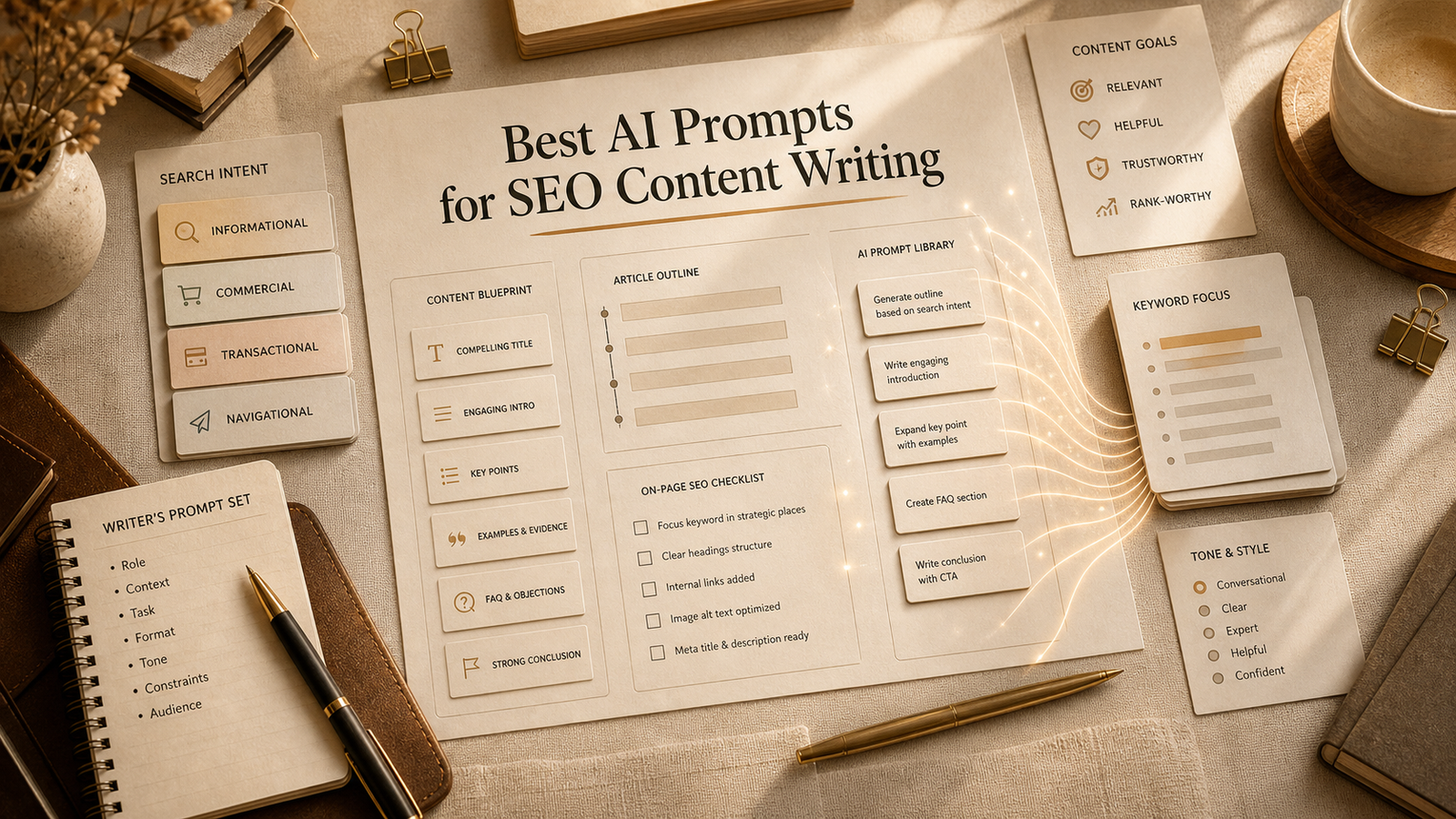
A better prompt sequence turns one keyword into a brief, a structure, examples, FAQs, internal links, and a review checklist. This makes the article easier to improve before publishing.
Why this matters
SEO writing needs decisions, not just words.
Useful SEO content answers a reader's problem with enough structure, specificity, and evidence to support the next step. AI can produce fluent copy quickly, but fluency does not prove usefulness.
When prompts separate planning from drafting, you can review the content strategy before the article becomes a wall of text.
Core problem
One-shot article prompts create generic output.
The core problem is that one-shot prompts compress too many tasks into one request. The model has to guess the reader, angle, examples, links, and quality bar at the same time.
That often produces content that sounds complete but lacks practical examples, source discipline, and a clear relationship to the rest of your site.
Workflow
A prompt sequence for SEO content.
Use these steps as a repeatable writing system.
Prompt 1: classify search intent, reader level, and likely objections.
Prompt 2: create a brief with article promise, sections, examples, and verification needs.
Prompt 3: draft the introduction and first section only.
Prompt 4: draft each remaining section with examples and constraints.
Prompt 5: suggest internal links, FAQs, metadata, and review risks.
Prompt 6: audit the article for thin sections, unsupported claims, and missing next steps.
Example prompt
Copy-ready SEO writing prompt.
Use this when you want a high-quality brief before drafting.
Copy-ready prompt
Act as an SEO content strategist and editor. For the keyword [KEYWORD], identify search intent, target reader, reader problem, article promise, required sections, practical examples, source or verification needs, internal link opportunities, FAQ candidates, and metadata direction. Do not write the article yet. Flag assumptions and risks before drafting.
Practical use case
From keyword to publishable draft.
If the topic is AI prompts for internal linking, the first output should be a brief that explains why internal links matter, what pages to map, how to choose anchors, and how to avoid forced links.
Only after that brief is reviewed should AI draft sections. The final article should include a prompt template, example link map, checklist, and CTA to a free NEOA resource.
Tools needed
A small toolkit is enough.
You need a keyword or topic, a site map or list of relevant pages, a prompt workspace, a review checklist, and a place to save reusable prompts.
Inside NEOA, the Prompt Library, Prompt Generator, and SEO Agent Skill Pack cover the core workflow during the free beta.
Mistakes to avoid
Do not confuse speed with quality.
Avoid prompts that ask for guaranteed rankings, fake data, unsupported source claims, or keyword-heavy sections that reduce clarity.
The best prompt is often the one that slows the model down enough to expose assumptions before generating final copy.
Recommended NEOA resource
Use NEOA's free beta SEO workflow.
Start with the Prompt Library for copy-ready templates. Use the Prompt Generator to customize them. When the process becomes repeatable, download the free SEO Agent Skill Pack.
You can also create a free account and save this workflow to your NEOA dashboard.
Detailed workflow
Run the prompt set as an editorial sequence.
The best AI prompts for SEO content writing work as a sequence because each output becomes an input for the next step. This prevents the model from hiding weak assumptions inside a polished draft.
Use the sequence below when a keyword is important enough to deserve a real article instead of a quick draft.
Intent pass: ask what the reader already knows, what they are trying to decide, and what would make the page genuinely useful.
Brief pass: create the article promise, section plan, practical examples, proof needs, internal link targets, and FAQ candidates.
Draft pass: write one section at a time with a required example, limitation, and next-step sentence in each section.
Edit pass: ask AI to identify generic claims, missing examples, repeated wording, unsupported statements, and weak transitions.
SEO pass: refine title, description, headings, internal links, and FAQs without forcing keywords into unnatural places.
Human QA pass: verify facts, remove filler, check links, and make sure the final article helps a real reader do the work.
Improved prompt
Use this prompt when the article must be practical.
This version forces the model to produce a useful brief, not a generic outline. It also makes review risks visible before drafting begins.
Copy-ready prompt
Act as a senior SEO editor. Build a practical content brief for the target keyword [KEYWORD]. Include: search intent, reader stage, reader problem, article promise, angle, H2 structure, section-by-section practical examples, source or verification needs, internal links from this approved list [URL LIST], FAQ candidates, metadata direction, and editorial risks. Do not draft the article yet. Flag any assumptions, avoid fake statistics, and explain how the brief will help the reader complete a real task.
Checklist
SEO content prompt quality checklist.
Before using AI output in a live article, check the prompt and the resulting draft against this list.
The prompt names the target reader and the decision the article should support.
The output includes examples, edge cases, or a real workflow instead of abstract advice only.
The model is told not to invent rankings, statistics, citations, testimonials, or source claims.
Internal links point to useful next steps such as NEOA prompts, the SEO Content Agent, or the free SEO Agent Skill Pack.
The final article can be reviewed section by section before publishing.
NEOA workflow
Use this best AI prompts for SEO content writing guide inside the AI SEO hub.
Treat "Best AI prompts for SEO content writing" as one part of the broader NEOA AI SEO workflow. Start from the hub when you need the surrounding topic cluster, then adapt the prompt, run the SEO Content Agent, and save the free resource for repeatable use.
Open the AI SEO hub to see where this guide fits in the full keyword-to-refresh cycle.
Use the Prompt Library or Prompt Generator to adapt the example prompt for your site and audience.
Use the SEO Content Agent and free SEO Agent Skill Pack when the workflow should become repeatable.
Keep the final output human-reviewed before publishing, refreshing, or adding structured data.
Related agent skill
SEO Content Agent Skill
A structured agent skill for turning a keyword into a full SEO content brief, article outline, metadata, FAQ schema plan, and social distribution assets.
Free NEOA resource
Explore free AI SEO prompts
Use NEOA's free prompt library to build briefs, outlines, drafts, FAQs, and review checklists during beta.
View resourceFree prompt pack
Get the prompt pack behind practical AI workflows.
Download 50 prompts for SEO, content, research, and business automation, then use them with this guide to make the workflow repeatable.
Free download
Get the prompt pack.
Choose your main interest and unlock the Markdown download.
Free during NEOA beta. You can download after submitting the form.
FAQ
Common questions
What is the best AI prompt for SEO writing?
The best prompt asks for a brief first: intent, reader, article promise, examples, source needs, internal links, FAQs, and review risks before drafting.
Can AI SEO prompts replace an editor?
No. They can structure the work and speed up drafting, but an editor should review accuracy, usefulness, examples, claims, and brand fit.
Where can I get free SEO prompts in NEOA?
Use the Prompt Library, the free prompt pack, or the SEO Agent Skill Pack. All are positioned as free during NEOA beta.
How many prompts should an SEO article workflow use?
Use enough prompts to separate planning, drafting, editing, and QA. For important content, a five-step sequence is usually safer than one large prompt.
How do I know an AI SEO draft is too generic?
Look for broad claims, repeated phrases, missing examples, no internal links, and advice that could apply to any topic without modification.
Final recommendation
Make the workflow repeatable before you scale it.
Use prompts as a writing workflow, not a shortcut around editorial judgment. Start with the brief, then move section by section.